The Press Release: the power of persuasion in pseudo-news.
2011-12-07
If you have been through my portfolio, you may already have an idea of the kinds of press releases I have written for both local and multi-national companies over the years. For those in a hurry or who do not have not have the time to browse, prefer to try your hand at writing your own press releases or just want some quick tips to improve your own works, the following will prove helpful to achieve your goals.
WHAT is a press release?
A press release is a contrived or affected news story, written with the main aim to exhibit the newsworthiness of a particular product, service, event (often product or service launch event) or individual. At most, the story should take up two A4 size pages. It is always written in third person to obtain the interest and as a matter of course, the support of an editor or reporter, which leads to it being printed in a targeted newspaper or news publication.
WHO is the press release written for?
A press release is sent to identified editors and reporters via email, fax or POS Malaysia. During events where invited editors are present, the press release is also often part of a full press kit. This full press kit is often in the form of a folder, which often contains a pitch letter, relevant product or service information, contact details of the product/ service representatives in case more information is required, and gift stationery sets. Today, as we move towards consuming news over the ‘world-wide web’ (www or w3), more and more often, the press release is also delivered via e-releases on Internet publications.
HOW to format a press release that rocks?
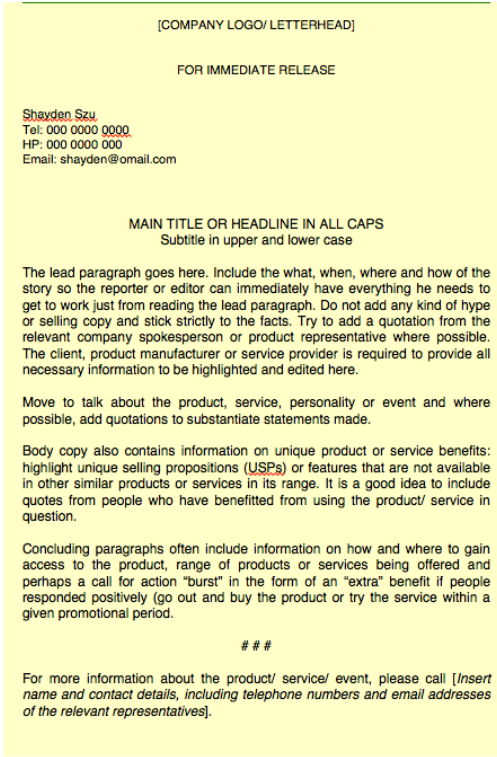
The press release always carries these key elements:
1. The company logo (and contact details) at the top of the page.
2. The words in all caps, “FOR IMMEDIATE RELEASE.”
3. The main title or headline, followed by a subtitle if necessary.
4. The story or body copy.
5. The symbols “# # #” to convey the end of the press release.
6. Contact details for more information.
To better illustrate how these key elements come together in a press release, below is a sample press release template you can copy and use immediately.
1. HOW to write a press release headline?
Begin with releasing your ego and relinquishing any pressure to sell or impress your client, your boss or yourself (esp. if you are writing for your own product). Now think about the person you are writing for: the reporter is NOT interested in helping you to boost your product sales or profits by driving customers to your outlet(s) or site. He or she is NOT interested in the extraordinary range of products the company may be offering, its magnificent customer relation services, expert staff force, production resources or mission statement.
Your target reader is only interested in information that will help him or her to churn out a story that will fascinate, appeal to and or entertain his readers. This means that the first thing you need to do is to entice the reporter/editor.
The headline must state or announce your most exciting news, in as few words as possible. Take your cues from attention-grabbing newspaper headlines.
Example of a bad press release headline:
AAA COMPANY IS NOW OFFERING A NEW FACIAL CREAM
THAT ALLOWS PEOPLE TO SHARE THEIR VIEWS ABOUT FACIAL APPEARANCES
Example of a good press release headline:
WOMEN: LOOK GREAT AND FEEL SUPERB, THE MALAYSIAN WAY
2. HOW to write a press release subtitle?
Now you have successfully gained the attention of your target (reporters and/or editors), the subtitle is your chance to build more interest. Support the headline and inject information about your newsworthy story.
Example of good press release headline and subtitle:
WOMEN: LOOK GREAT AND FEEL SUPERB, THE MALAYSIAN WAY.
100/100 Malaysian women testified that their skin appeared healthier and clearer within 5 days of using the locally produced 000 skin solution range.
3. HOW to write a press release lead paragraph?
Give your target reader all the information or facts that he or she needs in as few words as possible, to be able to gain a clear understanding of what your news is all about.
Stick to the facts.
Example of a bad press release lead paragraph:
In a recent groundbreaking ceremony at the city centre, the AAA organisation, which has been committed to customer satisfaction for over 100 years, launched their latest range of products. The company invited 100 women across Malaysia to try the products over a period of 5 days and results showed that every one of the women said that the state-of the art facial products dedicated to helping women across Malaysia, helped them to experience a better, more attractive complexion that contributed towards their overall daily well being.
Example of a good press release lead paragraph:
Malaysian women are relishing a new, 100% locally produced way to improve their complexion without spending a fortune on imported facial care products or using up hours in front of the mirror to treat, clean, tone and moisturise. Findings from a research performed to allow 100 women of all races across the country to use the products garnered positive results from all 100 women. According to the president of AAA company president Shayden Smurf, “cheer and satisfaction from using the locally cultivated and produced herbal skin care range reveal that regardless of race, Malaysian women appreciate a more local solution to a fast, no-nonsense, all-herbal solution that is ultimately more affordable than any other skin care product range of its kind, in the market.”
4. HOW to write a press release body copy?
The remainder of the press release serves to support all claims made in the headline, subtitle and lead paragraph. These following paragraphs elaborate on product or service claims.
Use quotes from company representatives and/or product users to support those claims, and where possible, bring in new positive information about the product or service that may be gleaned from the quotes (remember to ensure that product users have been duly notified that all that they have said about the product or service becomes the property of the company and may thus be used with copyright entitlement in the press release). Where you do not have the actual name or identification information about the individuals being quotes, use what you have. For example, “Account manager, Kuala Lumpur expressed, …” or use an professional in the field, “Skin specialist, Dr. Subra Lionel added that, …”
5. HOW to conclude a press release?
The final paragraph in any press release is known as the “boilerplate” and refers to a block of standard text that is used and re-used to conclude press releases. Place this final block of text right above the “## #”, which marks the end of the press release.
In a sentence or two, describe the company. For example, “The AAA organisation was established 100 years ago to provide both men and women with a range of skin care solutions that are produced using age-old, family knowledge about local herbs and spices. Today, its range of products may easily be bought off the shelves of pharmacies and shopping outlets across the country.
Finally, right below the “# # #”, add a call for action line such as, “For more information, please call our sales representative HOTLINE number: 0000 0000 or drop us an e-mail at: pr@myskinsolutions.com
Note:
My sole aim is to contribute towards improving the way our communication works so I welcome any further suggestions or thoughts you may have: please use the form below. All suggestions shared on this page will be duly credited to the author, with thanks.
THINGS TO REMEMBER
1. Hyperboles are exaggerated statements or claims that lack credibility on the grounds that they are not taken literally.
2. The use of hyperbole or adjectives such as “breakthrough”, “innovation” or “cutting-edge” will likely damage the tone of credibility you need to achieve in press releases.
3. Write from a journalist’s perspective. This means never saying “I”, “we” or “our” unless you are using a quote.
4. Keep an eye out for newspaper headlines that capture your attention to get a feel for the style you need to achieve in your press releases.
5. Shorter is always better. Saying it all in two pages is fine, but if you can say it all in one page, much better.
STARTER TIPS FOR REELING IN REPORTERS AND EDITORS
Good story angles begin with good answers from your clients and good answers begin with questions that elicit answers you can use. The following are some necessary questions you need to ask before you can bring to light that good story angle to entice your target reporter or editor.
1. What makes your business different from that of your competition?
Here, you need to weed out hyperbole answers that sound like “we are committed to offering only the finest quality” and get to the roots of that attention worthy story: get the client to reveal if the business serves a niche that no one else does, and exactly how. The next question will help.
2. How is your product or service better than others in the market?
Answers here could lead to special product or service features that could lead to a heart-racing headline and inevitably, a good story angle.
3. Are there ways in which the techniques or resources you use are new or original (exciting and newsworthy)?
4. Is there anything that makes your product or service controversial to current consumer market trends, competitors or experts in the field?
5. Are you doing anything different to ensure that your customers enjoy better value for their money?
6. Is your business involved in national community causes, aiding philanthropic projects or helping our society in any way?
Across your meeting(s), you will be able to root out several story angles that will make editors and reporters stand up and take notice, but you need to decide which is the best angle to work on and present that in the right way, so it touches the heartstrings of readers in ways that will help achieve your (clients’) goals.
7. A great site I found for ideas and samples of effective pitch letters:
http://www.publicityinsider.com/pitch.asp